Imagine you're writing the homepage for a new tool that helps consultants collect and use client testimonials. What should the page promise?
“Collect testimonials and grow your business” sounds reasonable. It also sounds like much of the market. To find a more useful starting point, we compared the websites of Senja, Testimonial.to, and Famewall.
This competitor analysis example shows what we learned, what we challenged in the AI answer, and how the findings became questions for customers. The business scenario is hypothetical. The Okou research conversation and screenshots are real, from a test workspace on November 24, 2026.
What the three companies emphasize
All three help businesses collect customer feedback and display it as social proof: evidence from other customers that can help a buyer feel more confident.
Their homepages give that work different emphasis:
| Product | Main message on the homepage | Examples that make it concrete |
|---|---|---|
| Senja | Collect verified testimonials, then use them across your marketing | Verification marks, searchable testimonials, widgets, images, videos, and case studies |
| Testimonial.to | Capture, measure, and showcase customer love | Testimonial collection alongside customer surveys, case studies, brand monitoring, and email follow-up |
| Famewall | Put customer proof on your website with little setup or upkeep | Collection links, imports, website widgets, and separate walls for a product, program, or client |
Sources: Senja, Testimonial.to, and Famewall, reviewed November 24, 2026. These are summaries of their messaging, not claims that a feature belongs exclusively to one product.
The useful finding is the overlap. A new homepage needs to explain more than “we collect testimonials.” It needs to show which customer problem the product handles particularly well.
Senja makes testimonials useful beyond a single webpage
Senja's homepage leads with collecting verified testimonials and case studies, then sharing them everywhere to increase trust and sales.
The page makes “everywhere” tangible. A testimonial can become a website widget, a social image, a video, or a case study. The site also describes searching for the right testimonial when writing a pitch, page, or post.
For a consultant, the relevant question is easy to understand: can a good client quote help with the next proposal as well as the website?
Senja also explains its verification marks. For example, its “Verified purchase” mark connects a testimonial author's email with a payment through Stripe. That's a specific claim about how a testimonial is checked. It doesn't independently prove that displaying the quote will increase sales.
What this suggests for our homepage: if we promise to help people use their testimonials, show where the quotes will go. A concrete proposal or service-page example says more than “share everywhere.”
Testimonial.to places testimonials inside a broader customer-feedback process
Testimonial.to's headline is “Capture, measure & showcase customer love.” Its homepage presents a collection page, an inbox, and a Wall of Love: an embeddable page or section displaying customer testimonials.
It also introduces other work around that core offer. Customers can answer questions for a case study, respond to a satisfaction survey, or receive an email asking for feedback. Brand monitoring looks for mentions on other platforms.
That creates a different question for our fictional business. Do consultants want another place to display quotes, or do they need help knowing whom to ask and when?
The page labels some of these capabilities with specific paid plans. A homepage showing the whole product family doesn't mean every feature comes with the entry plan.
What this suggests for our homepage: explain the particular part of the process we help with. If our product only collects quotes, we shouldn't imply it manages the whole customer relationship.
Famewall makes the website use case easy to picture
Famewall leads with testimonials and reviews that “keep selling for you on your website.” Its explanation follows a simple sequence: send a collection link, bring in reviews you already have, then display them in a widget or wall.
It names specific places to use the result: a homepage, pricing page, product page, program page, or service page. It also describes keeping separate walls for different products, programs, or clients.
For an independent consultant, this is recognizable work. Someone considering one service should see a relevant client story near the point where they decide to get in touch.
Famewall's homepage includes customer quotes about booking calls, quick setup, and embedding testimonials on a Notion site. Those are examples the vendor publishes. We have not independently checked the customers' reported results.
What this suggests for our homepage: show the actual page and the job it needs to do. “Put a relevant client story beside your consultation button” is clearer than “activate social proof,” if our product can deliver it.
What we changed after reviewing the AI answer
We asked Okou to compare the official websites and suggest ideas to investigate. The first answer found useful differences, but it also made claims that went beyond the pages.
One suggested angle said none of the products translated testimonial placement into small-business terms. Famewall's homepage already described product, program, and service pages. The proposed angle wasn't an undiscovered gap.
The answer also used phrases such as “broadest,” “closest small-business example,” and “unclaimed position.” A few company webpages can't establish those rankings or show that an audience is unserved.
We supplied that correction and narrowed the audience to independent consultants with a few client testimonials. The follow-up asked for three short product summaries, two ideas to investigate, and three customer questions. It also asked Okou to update the saved brief.
Click the screenshot to view it at full size.
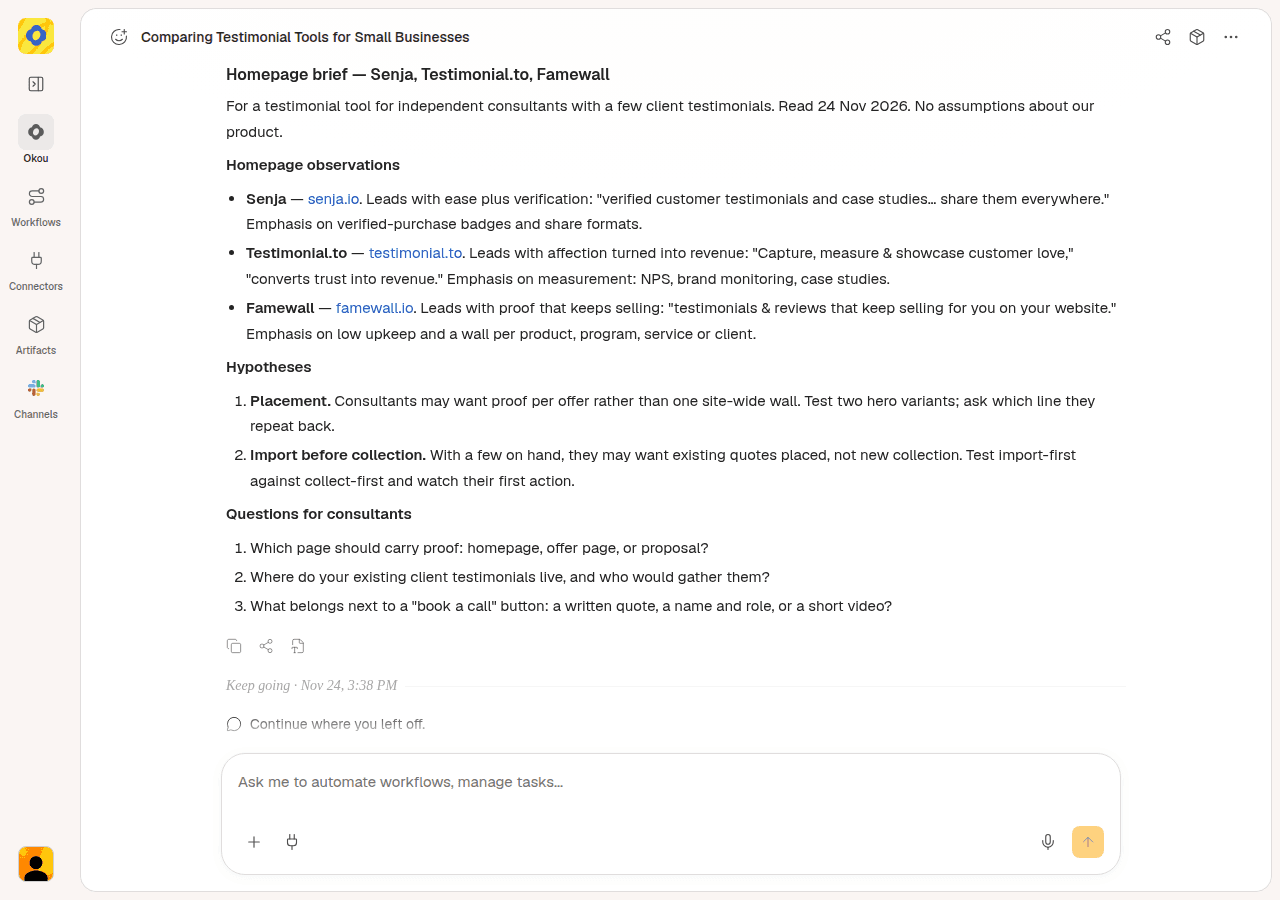
The reviewed Okou brief uses short paragraphs and keeps homepage observations separate from ideas to test.
This is the most useful part of the example: a source check changed what we would tell the homepage writer. For the full process, see how to do competitor research with AI.
Two ideas to investigate with customers
The research gives us questions to test. It doesn't tell us which message will win.
1. Make a few good testimonials more useful
A consultant may have five detailed client stories and no need to collect hundreds of short reviews. We could investigate whether they struggle to choose the right story for a proposal or service page.
Ask them to show the last proposal they sent. Which testimonial did they include? Why that one? Was finding and formatting it difficult?
If that work is already easy, this may be a weak reason to buy. If it is a repeated problem, we can test a message around it, provided the product actually helps.
2. Help people use feedback they already have
Useful praise may be sitting in email or an old project recap. Before promising to collect more, find out whether consultants want help turning existing, approved feedback into something they can publish.
Ask where the feedback lives, whether the client has agreed to public use, and what prevents it from reaching the website. The barrier could be permission, writing, design, or simply lack of time. Those are different problems.
All three competitors discuss importing or reusing existing proof. This idea therefore needs a specific customer problem and credible execution. It is not a claim that the market lacks import tools.
The brief we would give a homepage writer
Keep the decision short:
- What buyers already hear: collect testimonials, build trust, and use customer proof to support sales.
- What our page must make clear: which consultant, which task, and what useful result the product can deliver today.
- What we still need to learn: where those consultants keep feedback, how they choose a quote, and why it hasn't reached a proposal or webpage.
Don't write “the only testimonial tool for consultants” from this research. Write a concrete example our product can demonstrate, then check whether customers recognize the problem.
Frequently asked questions
Is this a review of which testimonial tool is best?
No. We studied public messaging. We didn't create accounts in these three products or compare their ease of use. A buying decision would also need requirements, current plan details, and a trial.
Can AI identify a gap in the market?
It can suggest a possible gap to investigate. Public websites alone can't establish customer demand or prove that no competitor serves a need. Treat the suggestion as a research question.
Can I use this method for a service business?
Yes. Compare the alternatives your customers actually consider, ask the same questions about each, and connect the findings to a decision such as rewriting a service page. Keep your own capabilities separate from what you observed about competitors.