Open three competitors’ websites and you may find three versions of the same promise: save time, grow faster, get more done. That doesn't tell you what to put on your own homepage.
AI can help you turn those pages into a useful comparison. Give it the companies you want to study and a specific question. Ask it to explain the differences, show where it found them, and suggest what to investigate next.
In this guide, we'll use Senja, Testimonial.to, and Famewall as an example. All three help businesses collect and display customer testimonials, but their websites emphasize different parts of that work. We ran the research in Okou on November 24, 2026, then checked and revised the answer. The screenshots show that conversation in a test workspace using public sources.
What should you get from AI competitor research?
A useful competitor analysis helps you make a decision. You might be deciding what to say on a landing page, which service to add, or how to explain your product in a sales call.
For a first pass, aim for a short comparison like this:
| Company | What its website emphasizes | Question this raises for your business |
|---|---|---|
| Senja | Verified testimonials that can become widgets, videos, images, and case studies | Where would our customers use their testimonials after collecting them? |
| Testimonial.to | Collecting, measuring, and showcasing customer feedback | Do buyers need a display tool or help with a broader feedback process? |
| Famewall | Putting testimonials on relevant webpages with little setup or upkeep | Can we show the specific page or task our product improves? |
Sources: Senja, Testimonial.to, and Famewall.
This is a summary of the companies’ public messaging, based on pages reviewed for this November 24, 2026 example. It doesn't tell us which product is easiest to use or why customers actually buy. Those questions need different evidence.
The table gives you a starting point: three differences worth exploring. Here's how to create one for your market.
1. Tell the AI what you need to decide
“Research my competitors” leaves the assistant to guess what matters. You may get company histories and feature lists when you needed help writing a sales page.
Start with a sentence about your work:
We're writing the homepage for a customer testimonial tool. I want to understand what Senja, Testimonial.to, and Famewall each emphasize, so we can explain our own offer more clearly.
You can adapt that to a service business:
We run a bookkeeping service for small agencies. Compare how these three competitors explain their services, prices, and onboarding. We need to decide what to include on our pricing page.
The decision keeps the research focused. If you're working on messaging, study the promises companies make and how they support them. If you're choosing software to buy, start with your team's requirements instead. Our client approval software comparison shows that approach.
2. Give it a manageable set of competitors
Start with companies your customers would realistically consider. A few relevant alternatives are more useful than a long list of vaguely similar businesses.
If you already know your competitors, provide their names and website links. If you don't, ask the assistant to suggest candidates and explain why each belongs. Check that list before it starts the detailed comparison.
For example, a bookkeeping service might compete with another agency, an independent accountant, and the customer's decision to keep doing the work in a spreadsheet. Those alternatives solve the same problem in different ways. Comparing only companies that look like yours can miss what the customer is choosing between.
For this walkthrough, we're keeping the scope to three customer testimonial tools. That makes the example easy to follow; it isn't a rule that every analysis should contain three companies.
3. Ask the same questions about every company
Comparisons become confusing when one column describes pricing, another lists features, and the third talks about customer reviews.
Give the assistant the questions you want answered. For a messaging comparison, these work well:
- Who does the company appear to be talking to?
- What benefit does it lead with?
- What features or examples support that promise?
- What is still unclear?
You can use this prompt in Okou's competitor analysis tool, or another assistant that can read current web pages:
I am planning the homepage for a new customer testimonial tool for small businesses. Compare Senja (senja.io), Testimonial.to, and Famewall (famewall.io) using their current official websites. For each, explain who it seems to address, what benefit it leads with, and which examples support that promise. Put the findings in a short table with source links. Identify promises they share and two messaging angles worth investigating. Separate observed facts from interpretations and questions for customers. Do not assume our product has features I have not described. Keep it in plain English and save a concise Markdown brief.
This is the request we submitted. Notice that it names the decision, the competitors, and the output we need.
Click the screenshot to view it at full size.
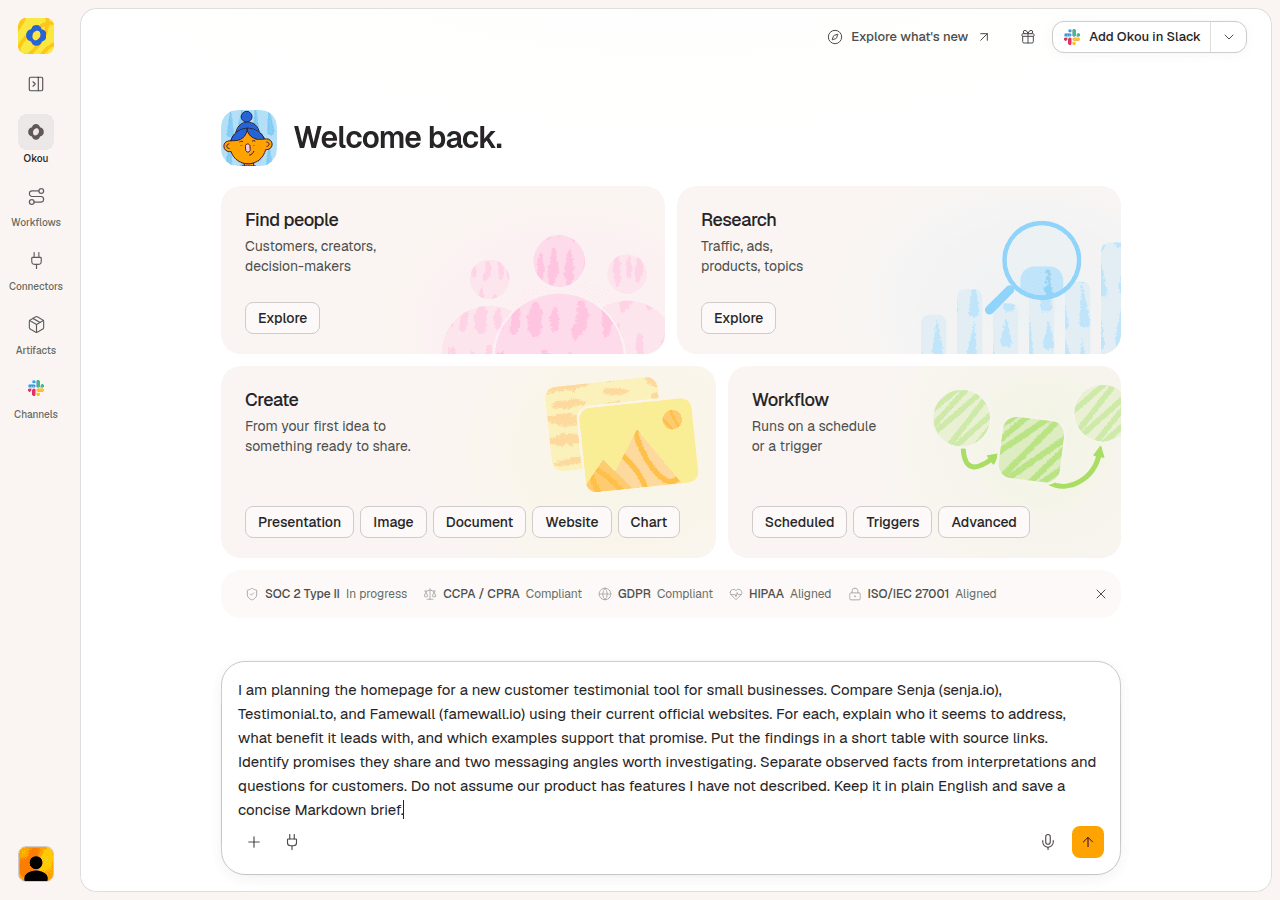
The actual starting request in Okou. Giving the homepage project as context keeps the task focused on messaging.
If the assistant cannot open a page, give it the relevant text or document. Ask it to say which sources it couldn't read. A list of links in the answer isn't enough to show that it used their contents.
4. Ask what each difference means
Once you have a table, ask a follow-up question. This is where the research starts to help with your work.
For example:
Explain what these differences would mean for our homepage. Which promises are already common? What would we need to demonstrate to make our own claim believable?
Consider Senja's emphasis on using testimonials in several formats. Its homepage shows widgets, social images, videos, and case studies. A new product promising to “make more of your testimonials” would need to explain the particular job it handles well.
That could lead you to investigate a consultant's proposal-writing process. Does the consultant struggle to find a relevant client quote, get permission to use it, or place it in the proposal? Those are questions for customers, not answers hidden in a competitor's website.
Write that distinction into the result:
What we found: Senja presents several ways to use a testimonial after collecting it.
What to investigate: Whether independent consultants need help choosing and using a few relevant client stories in proposals.
Now you have a question for customer interviews or product discovery. You haven't invented proof of demand from a competitor's homepage.
5. Check the claims that could change your plan
Before you use the report, open the sources behind its most important conclusions. Start with claims about a competitor's missing feature, a price advantage, or a restriction on how customers can use the product.
Our first answer suggested that none of the three companies made testimonial placement concrete for small businesses. But Famewall's homepage already named product, program, and service pages. The proposed idea wasn't an undiscovered market gap.
We pointed that out and asked Okou to remove unsupported phrases such as “broadest” and “unclaimed position.” We also narrowed the audience to independent consultants with a few client testimonials. That gave the next brief a clearer job.
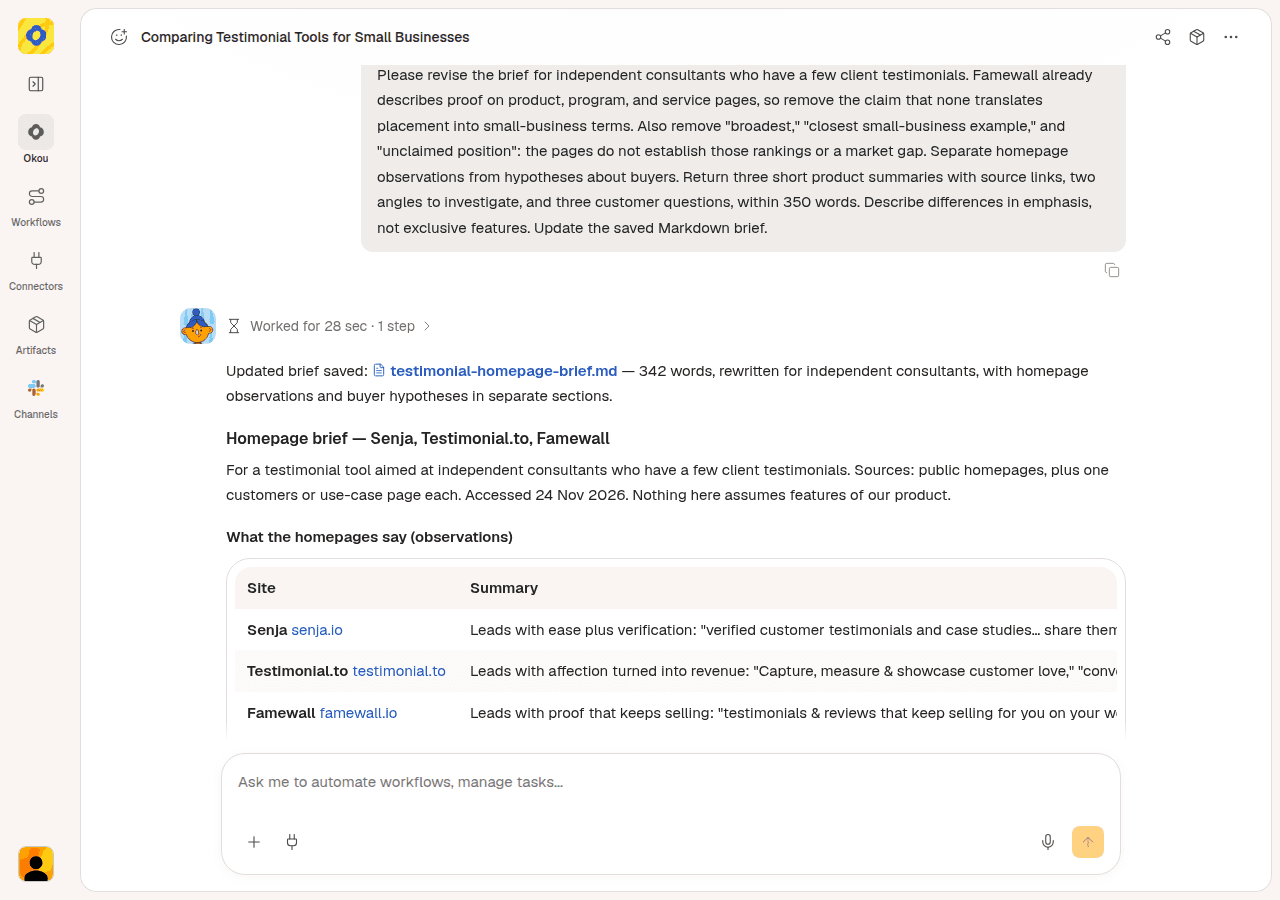
The actual follow-up in Okou corrects the source interpretation and narrows the audience. The revised brief separates observations from ideas to test.
You don't need to turn every research session into a complicated audit. Ask:
Show me the original page supporting this statement. Does it describe the same feature and plan we're discussing?
If the answer is unclear, keep the question open. “We haven't confirmed this” is more useful than a confident mistake in a client presentation. For a fuller walkthrough, see how to fact-check AI research.
6. Turn the findings into something your team can use
A research report should leave you with a next step. For a homepage project, ask for a short brief containing:
- What the competitors already emphasize.
- What your company can honestly say differently.
- What you still need to learn from customers.
For example, you could ask Okou:
Turn this comparison into a one-page brief for our homepage writer. Include the three main findings and their source links. Suggest two messaging angles to explore, but don't claim we offer a feature unless it's in the product notes I've provided.
The product notes matter. Research about competitors cannot tell the assistant what your own business can deliver. Supply your current offering, audience, and relevant customer feedback so the suggestions have something concrete to work with.
Keep the conversation going as you review the brief. If an angle feels wrong, explain why: “Our customers already have a few detailed testimonials. They need help using those stories in proposals, rather than running a large review-collection campaign.” That correction changes what the comparison should focus on.
Our reviewed brief ended with three product summaries, two messaging ideas to investigate, and three questions for customers. We then asked for short paragraphs instead of a wide table so it would be easier to read and share. It gave the writer a next step while keeping untested ideas separate from findings.
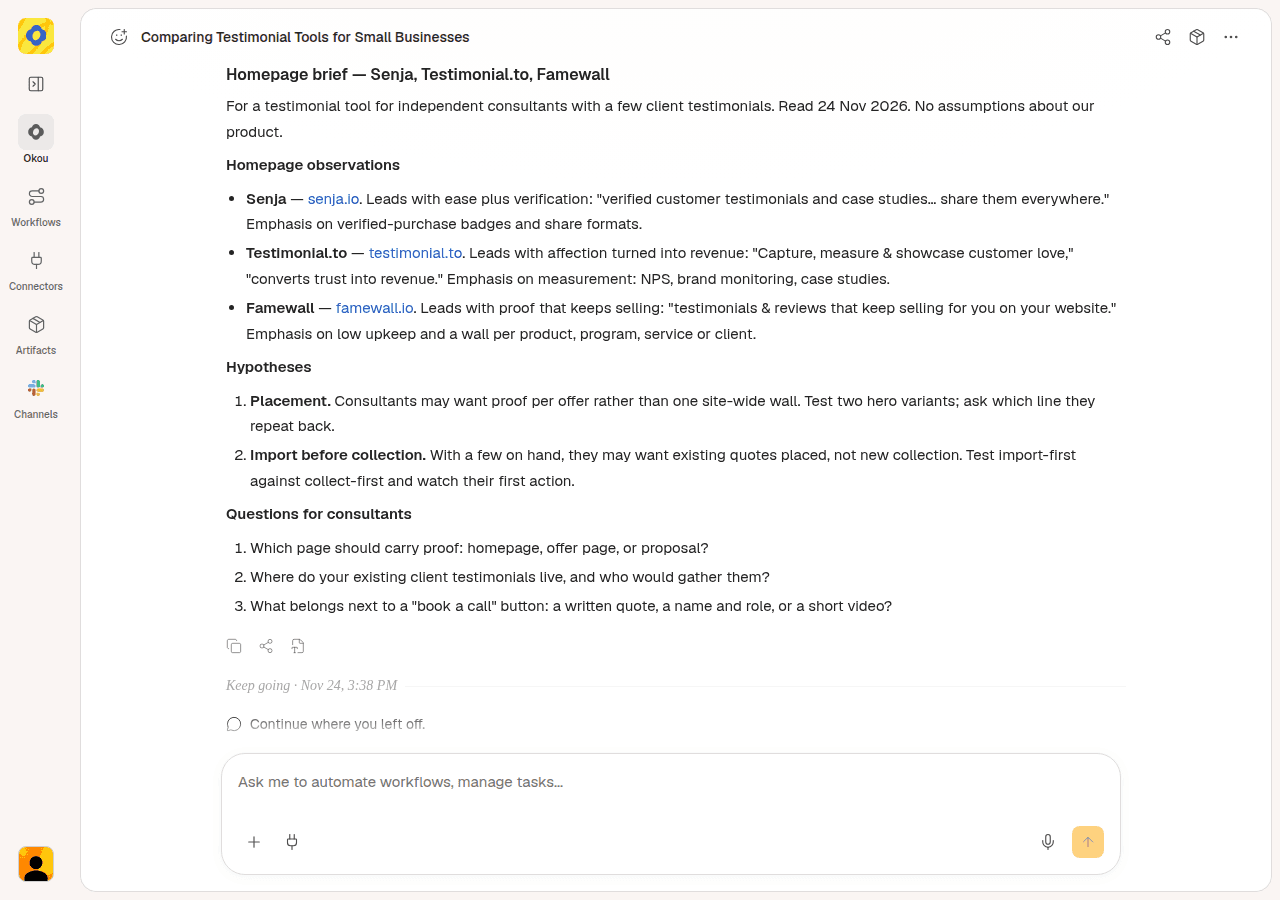
The reviewed result connects product differences with questions for customer research. The suggested messaging still needs testing.
Where to go after the first comparison
Public websites are a good place to study what companies say about themselves. To understand customer experience, add reviews or interviews. To compare ease of use, try the same task in the products. To understand search visibility, use search and traffic data.
Choose the next source based on the question you still need to answer. You can see the longer Senja, Testimonial.to, and Famewall analysis for an example of interpreting public messaging without turning it into a product ranking.
Frequently asked questions
Can I use ChatGPT or another general assistant for competitor research?
Yes. Use a tool that can retrieve the sources you need, or provide those sources yourself. Give it the business question and ask for links beside important facts. Check its answer before using it in a decision or public claim.
How many competitors should I include?
Begin with the alternatives your buyers actually consider. Add more when they represent a different approach or customer segment you need to understand. A focused comparison is easier to review than a directory with little explanation.
Should AI write a SWOT analysis?
It can help draft one. Ask it to explain each strength or weakness in relation to your customer and link the supporting evidence. A feature gap matters only if the buyer needs that feature.
How often should I update the research?
Recheck it when you're about to use it for an important decision, such as a launch, price change, or sales proposal. Prices and product capabilities can change more quickly than a company's overall message.